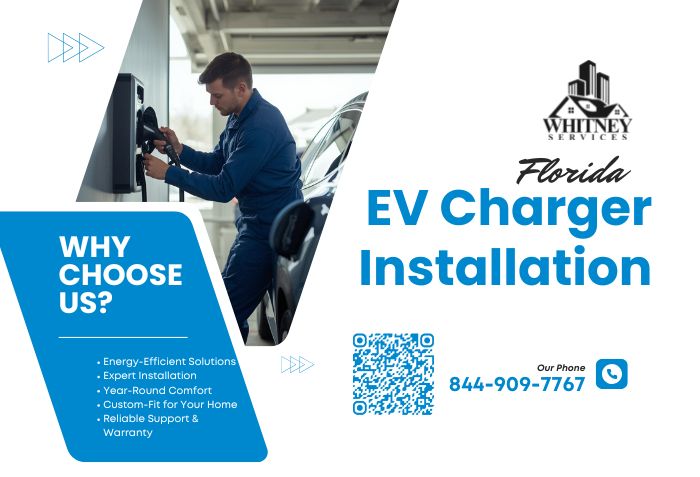
Electric vehicle ownership continues growing in Key Biscayne as residents embrace sustainable transportation, yet many EV owners rely on slow standard outlets for home charging creating overnight charging challenges. Professional Level 2 home EV charger installation provides faster convenient charging, adds home value, and eliminates dependence on public charging stations. At Whitney Services, we provide EV charger installation in Key Biscayne with certified electricians experienced in all major EV charging systems.
Benefits of Home EV Charger Installation
Professional charging installation provides multiple advantages over standard outlet charging.
Faster charging from Level 2 chargers delivering 240 volts charges EVs 3 to 7 times faster than standard 120-volt outlets. Full overnight charging becomes reliable rather than uncertain.
Convenience of home charging eliminates trips to public charging stations saving time and providing reliable charging availability.
Cost savings compared to public charging stations which often charge premium rates. Home electricity rates make home charging significantly cheaper per mile.
Home value increase as EV charger installation adds appeal for future buyers as electric vehicle adoption grows.
Scheduling flexibility with programmable chargers taking advantage of off-peak electricity rates where available.
Smart features in modern chargers including WiFi connectivity, usage tracking, and smartphone control providing convenience and insights.
Weather protection from covered charging locations avoiding exposure to elements during charging at home.
EV Charger Installation Cost in Key Biscayne
Understanding pricing components helps budget for professional EV charger installation.
Equipment costs for Level 2 home EV chargers range from $400 to $1,200 depending on brand, features, and power output. Basic 32-amp chargers cost $400 to $600 while premium 48-amp smart chargers cost $800 to $1,200.
Installation labor costs range from $500 to $1,500 depending on installation location, distance from electrical panel, circuit availability, and complexity.
Electrical panel considerations including whether existing panel has capacity for 40 to 60-amp dedicated circuit or requires panel upgrade adding $2,000 to $4,000.
Permit and inspection fees add $100 to $200 covering required electrical permits and inspections.
Additional components including conduit, wire, mounting hardware, and junction boxes add $200 to $500 depending on installation distance and method.
Total typical installation costs range from $1,200 to $2,500 for straightforward installations with adequate electrical capacity.
Complex installations requiring panel upgrades, long wire runs, or challenging mounting locations cost $2,500 to $5,000 or more.
Level 2 vs Level 1 Charging Comparison
Understanding charging level differences helps determine appropriate home charging solution.
Level 1 charging uses standard 120-volt household outlets providing 3 to 5 miles of range per hour. Requires no special installation but charges very slowly often taking 20+ hours for full charge.
Level 2 charging uses 240-volt circuits like electric dryers providing 15 to 40 miles of range per hour depending on charger amperage and vehicle capacity. Charges most EVs overnight in 4 to 8 hours.
Amperage ratings affect charging speed. 32-amp chargers deliver about 25 miles per hour while 48-amp chargers deliver 35 to 40 miles per hour to vehicles supporting higher charging rates.
Cost comparison shows Level 1 charging is free using existing outlets but inconveniently slow while Level 2 installation costs $1,200 to $2,500 but provides practical daily charging.
Vehicle compatibility as all EVs accept Level 2 charging though charging speed varies by vehicle onboard charger capacity.
Tesla Charger Installation in Key Biscayne
Tesla vehicles can use Tesla-specific or universal charging equipment requiring specific installation considerations.
Tesla Wall Connector represents Tesla’s proprietary home charger providing up to 44 miles of range per hour. Costs $425 for equipment plus $500 to $1,500 installation.
Universal J1772 chargers work with all EVs including Tesla vehicles using included adapter. Provides flexibility if household adds non-Tesla EV.
Hardwired vs plug-in installation with hardwired providing cleaner appearance and avoiding outlet requirements while plug-in offers portability.
WiFi connectivity in Tesla Wall Connector enables usage tracking, over-the-air updates, and power sharing between multiple units.
Installation requirements include dedicated 60-amp circuit for maximum 48-amp charging or 40-amp circuit for reduced 32-amp charging.
Location considerations for Tesla installations including garage placement, outdoor weatherproof locations, or carport installations.
Home EV Charger Electrician Selection
Choosing qualified electricians ensures safe proper EV charger installation.
Licensed electrician requirement with Florida electrical contractor license ensuring qualified installations meeting code requirements.
EV charger installation experience specifically with Level 2 charger installations demonstrating relevant expertise.
Manufacturer certification for specific charger brands when required ensuring warranty compliance and proper installation.
Insurance coverage including general liability protecting homeowners from installation damage.
Knowledge of EV charging codes including NEC Article 625 governing EV charging equipment installation.
Electrical panel assessment skills determining whether existing service supports EV charger or requires upgrades.
Quality installation practices including proper circuit sizing, appropriate materials, and clean professional workmanship.
Electric Car Charger Setup Process
Understanding installation steps helps homeowners prepare for EV charger projects.
Site assessment by electrician evaluating installation location, measuring distance to electrical panel, assessing panel capacity, and determining installation requirements.
Charger selection guidance helping choose appropriate charger based on vehicle requirements, budget, and desired features.
Electrical capacity verification through load calculation determining if existing service supports additional EV charger load.
Permit application obtaining required electrical permits before installation.
Circuit installation running dedicated 40 to 60-amp circuit from electrical panel to charging location using appropriate wire gauge and protection.
Mounting charger installation securing charger to wall, post, or pedestal at appropriate height and location.
Connection and testing wiring charger per manufacturer specifications and testing operation.
Inspection scheduling and passing required electrical inspection.
User training explaining charger operation, features, and maintenance.
Timeline typically 1 day for straightforward installations or 2 to 3 days including panel upgrade if needed.
Key Biscayne EV Charger Installation Considerations
Island location creates specific installation factors.
Saltwater environment requiring corrosion-resistant materials and weatherproof installations protecting equipment from coastal conditions.
Outdoor installations common in Key Biscayne requiring NEMA 3R or 4 rated weatherproof chargers and proper mounting.
Hurricane preparation including secure mounting meeting wind load requirements and positioning protecting from storm damage.
Condominium installations requiring HOA approval, building management coordination, and compliance with building electrical capacity.
Luxury home integration matching charger aesthetics to high-end home appearance and integrating with smart home systems.
Multiple vehicle households potentially requiring dual chargers or load-sharing solutions.
Parking configuration including garages, carports, or open parking affecting installation approach.
Popular EV Charger Brands and Features
Various manufacturers offer residential charging solutions with different capabilities and price points.
Tesla Wall Connector for Tesla owners providing up to 44 miles per hour charging, WiFi connectivity, and power sharing. Costs $425 equipment.
ChargePoint Home Flex universal charger with adjustable amperage, WiFi connectivity, and smartphone app. Costs $700 equipment.
JuiceBox 40 or 48 affordable smart charger with WiFi, smartphone control, and voice assistant integration. Costs $600 to $650 equipment.
Grizzl-E budget-friendly durable charger without smart features providing reliable basic charging. Costs $400 to $500 equipment.
Emporia smart charger with energy monitoring, solar integration capability, and competitive pricing. Costs $450 to $550 equipment.
Wallbox Pulsar Plus compact European design with Bluetooth and smartphone app. Costs $650 equipment.
Features to consider including hardwired vs plug-in, smart connectivity, cable length, adjustable amperage, and outdoor rating.
Electrical Panel Capacity Requirements
Adequate electrical service capacity is essential for EV charger installation.
Load calculation by licensed electrician determines total electrical demand including EV charger ensuring panel capacity is adequate.
Typical EV charger requirements include 40-amp circuit for 32-amp charging or 60-amp circuit for 48-amp charging.
Panel capacity needs 200-amp service typically adequate for single EV charger plus typical home loads. Homes with 100-amp service often require panel upgrade.
Available circuit breaker space requiring 2-pole breaker space in panel for EV charger circuit.
Panel upgrade necessity when existing service is insufficient adding $2,000 to $4,000 to project cost.
Load management solutions including smart chargers reducing power during peak home usage preventing overload.
Utility notification some utilities require notification before EV charger installation for load planning.
Permits and Code Compliance
Proper permitting ensures legal safe EV charger installations.
Permit requirements mandate electrical permits for EV charger installation in Key Biscayne and throughout Florida.
NEC Article 625 governs electric vehicle charging equipment installation including circuit requirements, disconnect location, and GFCI protection.
GFCI protection requirements for garage and outdoor installations protecting against ground faults.
Disconnect requirement accessible disconnect within sight of charger for maintenance and emergency shutoff.
Wire sizing based on circuit amperage and distance preventing voltage drop and overheating.
Grounding requirements proper equipment grounding and bonding for safety.
Inspection process including rough-in and final inspections verifying code-compliant installation.
Booking EV Charger Installation
Scheduling professional installation involves several steps.
Initial consultation discussing vehicle type, desired charging speed, installation location, and budget.
Site evaluation in-person or virtual assessment of electrical panel, proposed charger location, and installation requirements.
Detailed estimate including equipment recommendations, installation scope, timeline, and total costs.
Equipment ordering selecting and purchasing chosen charger directly or through electrician.
Installation scheduling coordinating convenient installation date minimizing disruption.
Permit processing allowing time for permit approval before installation.
Installation day with professional installation typically completing in 4 to 8 hours.
Final testing and walkthrough ensuring proper operation and understanding charger features.
Why Choose Whitney Services
EV charger installation requires electrical expertise ensuring safe code-compliant installations. Whitney Services provides professional EV charger installation in Key Biscayne with certified electricians experienced in all major charging systems.
We assess electrical capacity accurately, recommend appropriate chargers, obtain permits, install equipment correctly, and ensure inspection approval.
If you need EV charger installation, contact Whitney Services today for expert installation service and detailed pricing.
Frequently Asked Questions
Q1: How much does EV charger installation cost?
Total installation costs range from $1,200 to $2,500 for straightforward installations including $400 to $1,200 equipment and $500 to $1,500 labor. Complex installations or panel upgrades cost $2,500 to $5,000+.
Q2: How long does EV charger installation take?
Standard installation requires 4 to 8 hours completing in single day. Installations requiring panel upgrades take 1 to 2 days including panel replacement and charger installation.
Q3: Can any electrician install EV charger?
Licensed electricians can install EV chargers but experience with EV charging installations ensures proper circuit sizing, code compliance, and optimal charger selection.
Q4: What size circuit does EV charger need?
Most Level 2 home chargers require dedicated 40 to 60-amp 240-volt circuits depending on charger amperage rating. 32-amp chargers need 40-amp circuits while 48-amp chargers need 60-amp circuits.
Q5: Do I need permit for EV charger installation?
Yes, EV charger installation requires electrical permits in Key Biscayne and throughout Florida. Licensed electricians obtain permits and coordinate required inspections ensuring legal installations.