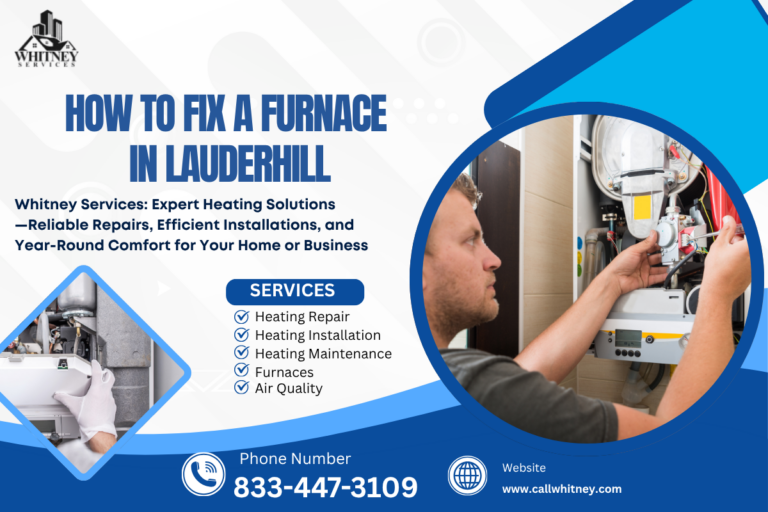
If you are wondering how to fix a furnace in Lauderhill, start with a few safe checks before attempting any repair. Check the thermostat, air filter, power supply, and airflow, then stop troubleshooting if you notice a gas odor, burning smell, electrical problem, ignition issue, or another safety concern. Problems involving gas, electrical components, burners, ignition systems, or internal furnace parts should be evaluated by a qualified HVAC professional. Lauderhill has generally mild winters, but cooler weather and winter cold fronts can still make a dependable heating system important for indoor comfort. Whitney Services provides heating repair, furnace repair, furnace maintenance, thermostat troubleshooting, and other heating services for Lauderhill homeowners and businesses.
Knowing how to fix a furnace in Lauderhill does not mean every repair should be a DIY project. The goal is to identify simple problems safely, recognize when professional service is necessary, and avoid actions that could damage the furnace or create a safety hazard.
Key Takeaways
- Start with the thermostat, filter, power supply, and visible airflow.
- A furnace that runs but does not produce enough heat may have an airflow, thermostat, ignition, or internal component problem.
- Strange noises, repeated cycling, unusual odors, and ignition problems should not be ignored.
- Do not attempt gas, combustion, electrical, or internal furnace repairs yourself.
- A professional diagnosis can determine whether the problem is with the furnace, thermostat, airflow, or another part of the heating system.
- Annual heating maintenance can help identify developing problems before they become major breakdowns.
- Whitney Services offers professional heating and furnace repair in Lauderhill, including 24/7 emergency heating service.
What Should I Check First If My Furnace Is Not Working?
When learning how to fix a furnace in Lauderhill, begin with basic checks that do not require opening the furnace or handling internal components.
Check the Thermostat
Make sure the thermostat is set to heat and that the desired temperature is higher than the current indoor temperature. If the thermostat uses batteries, replace them if they are weak or depleted. Also check whether the thermostat display is operating normally. A blank display or inconsistent readings can point to a thermostat or electrical problem rather than a furnace failure.
Check the Furnace Filter
A dirty filter can restrict airflow and make it harder for the heating system to circulate warm air. If your furnace uses a replaceable filter, check its condition and replace it according to the manufacturer’s requirements when it is dirty. A filter check is one of the simplest steps in how to fix a furnace in Lauderhill because it does not require you to work on the furnace itself.
Check the Power Supply
Confirm that the furnace has power and that its service switch has not been accidentally turned off. You can also check the appropriate circuit breaker. If a breaker repeatedly trips after being reset, do not keep resetting it. Repeated electrical trips can indicate an underlying problem that requires professional diagnosis.
Check the Vents and Airflow
Make sure supply vents are open and are not blocked by furniture, rugs, curtains, or other objects. If airflow is weak throughout the home, the issue may involve the filter, ductwork, blower, or another part of the heating system.
Whitney Services also lists airflow problems and ductwork services among the heating issues and related services it handles in Lauderhill.
What Are the Most Common Furnace Problems in Lauderhill?
Understanding common symptoms makes how to fix a furnace in Lauderhill easier to approach because different symptoms can point toward different types of problems.
The Furnace Does Not Turn On
A furnace that does not start may have a thermostat problem, power interruption, control issue, ignition problem, or another internal malfunction. After checking the thermostat and power supply, avoid opening the furnace to investigate internal components. A qualified technician can safely determine why the heating cycle is not starting.
The Furnace Runs but Does Not Heat Properly
If the blower runs but the home remains cold, possible causes include restricted airflow, thermostat problems, ignition issues, burner problems, or other equipment faults. Do not assume the furnace itself is always the cause. Air distribution problems, ductwork issues, and thermostat controls can also affect how much heat reaches different rooms.
The Furnace Short Cycles
Short cycling occurs when a furnace repeatedly starts and stops instead of completing a normal heating cycle. Possible contributing factors include airflow restrictions, thermostat problems, equipment issues, or other conditions affecting system operation. Repeated cycling should be professionally evaluated rather than treated as a minor inconvenience. Whitney Services identifies frequent cycling and irregular operation as warning signs that a heating system may need professional attention.
The Furnace Makes Strange Noises
Banging, rattling, squealing, grinding, or repeated clicking can indicate that something is not operating normally. The sound alone does not identify the failed component, so avoid replacing parts based only on a noise. A technician can inspect the system and determine whether the issue involves the blower, motor, ignition system, loose components, or another part.
The Furnace Produces Uneven Heating
If some rooms are comfortable while others remain cold, the problem may involve airflow, ductwork, thermostat operation, system performance, or another distribution issue. Uneven temperatures are one of the heating warning signs Whitney Services identifies for Lauderhill properties.
If you are unsure how to fix a furnace in Lauderhill, start with safe troubleshooting and contact Whitney Services for professional diagnosis when the problem persists or involves a component that should not be handled without HVAC expertise.
Which Furnace Problems Can I Fix Myself?
A homeowner can handle limited maintenance and troubleshooting tasks, but how to fix a furnace in Lauderhill should never involve unsafe work on gas, electrical, combustion, or internal furnace components.
Safe Checks You Can Perform
You can generally:
- Check the thermostat setting.
- Replace thermostat batteries when applicable.
- Inspect and replace a dirty furnace filter.
- Confirm the furnace has power.
- Check that the furnace switch has not been turned off.
- Make sure supply vents are open.
- Remove obvious obstructions around vents.
- Observe the furnace for unusual noises, odors, or repeated cycling.
These checks can help you determine whether a simple issue is affecting performance without requiring you to dismantle the equipment.
Repairs You Should Leave to a Professional
Do not attempt to repair or modify:
- Gas valves or gas connections
- Burners
- Ignition components
- Electrical controls
- Control boards
- Combustion components
- Heat exchangers
- Internal wiring
- Other components requiring specialized testing
Working on these components without the appropriate training and equipment can create safety risks and may cause additional equipment damage.
When Should I Stop Troubleshooting and Call an HVAC Professional?
Knowing when to stop is an important part of how to fix a furnace in Lauderhill. If basic checks do not restore normal operation, professional diagnosis is the safer next step.
Call an HVAC professional when:
- The furnace will not turn on after basic checks.
- The system repeatedly shuts down.
- The circuit breaker keeps tripping.
- The furnace produces unusual or persistent noises.
- Heating remains uneven.
- The system repeatedly short cycles.
- The ignition or pilot system is malfunctioning.
- The furnace produces an unusual burning smell.
- The problem returns after a temporary improvement.
Whitney Services provides Lauderhill heating diagnostics and repairs for issues involving thermostats, airflow, ignition, and uneven heating.
Watch for Potential Safety Emergencies
A gas odor, smoke, strong burning smell, suspected carbon monoxide issue, or serious electrical problem should not be treated as a routine troubleshooting situation.
If you smell gas or suspect carbon monoxide, leave the property and contact the appropriate emergency service or gas utility from a safe location. Do not return to the area or continue troubleshooting until it is safe to do so.
How Does Professional Furnace Repair Work in Lauderhill?
If you still need to know how to fix a furnace in Lauderhill after completing the basic checks, a professional diagnostic process can identify the actual cause instead of relying on guesswork.
1. Initial Assessment
The technician will ask about the symptoms, when the problem started, and whether anything changed before the furnace stopped working properly.
2. System Inspection
The technician can inspect the thermostat, furnace, controls, airflow, and relevant components to determine where the problem originates.
3. Diagnostic Testing
Testing helps distinguish between problems involving the thermostat, ignition, airflow, electrical components, or other parts of the heating system.
4. Repair Recommendation
Once the cause has been identified, the technician can explain the recommended repair and whether additional work is necessary.
5. Repair and System Testing
After the appropriate repair is completed, the system should be tested to verify that it is operating correctly and providing the expected heating performance.
Whitney Services states that its Lauderhill service process includes detailed diagnostics, clear explanations, transparent pricing, professional repairs or installation, final walkthroughs, and post-service follow-up.
Should I Repair or Replace My Furnace?
Sometimes the best answer to how to fix a furnace in Lauderhill is not a repair. The right decision depends on the furnace’s age, condition, repair history, performance, efficiency, and the type and severity of the problem.
Repair May Make Sense When:
- The furnace is otherwise reliable.
- The problem involves a repairable component.
- The system has been properly maintained.
- The repair can restore safe and dependable operation.
- The cost of repair is reasonable compared with replacement.
Replacement May Be Considered When:
- The furnace is reaching the end of its useful service life.
- Repairs are becoming frequent.
- Performance continues to decline.
- The system has significant efficiency or reliability concerns.
- A major repair is needed.
A professional evaluation can help you compare the condition of the existing furnace with the benefits and costs of replacement. Whitney Services provides both furnace repair and furnace replacement services as part of its Lauderhill heating offerings.
How Can I Prevent Furnace Problems in Lauderhill?
Preventive care can reduce the likelihood of needing to fix a furnace in Lauderhill because routine maintenance can identify developing problems before they cause a major breakdown.
Schedule professional heating maintenance annually, preferably before the cooler months. Regular maintenance can include inspections, safety checks, system testing, adjustments, burner inspections, and airflow evaluation.
Homeowners can also:
- Replace or clean filters as recommended.
- Keep supply vents unobstructed.
- Pay attention to unusual sounds or odors.
- Address uneven heating instead of ignoring it.
- Watch for repeated cycling.
- Schedule professional service when performance changes.
Whitney Services recommends annual heating maintenance and explains that routine service can support reliable performance, energy efficiency, and longer equipment life.
Why Choose Whitney Services for Furnace Repair in Lauderhill?
When basic troubleshooting does not solve the problem, Whitney Services provides professional heating and furnace repair in Lauderhill. The company states that its HVAC professionals are licensed and insured, provides transparent pricing, and offers same-day and 24/7 emergency heating services.
The service process is designed to provide clear communication from scheduling through diagnosis, repair, system testing, and follow-up. This approach helps homeowners understand what is wrong with the furnace and what work is recommended before the repair proceeds.
What Should I Do If My Furnace Still Does Not Work?
If you are still searching for how to fix a furnace in Lauderhill after checking the thermostat, filter, power supply, and vents, do not continue experimenting with internal components.
Instead:
- Turn the thermostat to the appropriate heating setting.
- Check the filter.
- Confirm the furnace has power.
- Make sure vents are open and unobstructed.
- Stop troubleshooting if you notice a gas, burning, electrical, or combustion-related warning sign.
- Contact a qualified HVAC professional for diagnosis.
Understanding how to fix a furnace in Lauderhill is mainly about knowing what you can safely check and recognizing when professional service is needed. For persistent furnace problems, Whitney Services can inspect the system, identify the cause, explain the available repair options, and help restore reliable heating in your Lauderhill home.
Conclusion
Knowing how to fix a furnace in Lauderhill starts with safe, basic troubleshooting, such as checking the thermostat, filter, power supply, and airflow. If the furnace continues to malfunction or you notice unusual odors, repeated cycling, ignition problems, electrical issues, or other warning signs, avoid attempting internal repairs and have the system professionally inspected.
A proper diagnosis can determine whether the problem comes from the furnace, thermostat, airflow, ductwork, or another heating component. Whitney Services can help identify the cause, explain the recommended repair, and restore reliable heating when professional service is needed. Contact us today for dependable furnace troubleshooting and repair in Lauderhill.
Frequently Asked Questions
1. How do I fix a furnace that is not turning on?
If you are learning how to fix a furnace in Lauderhill, first check the thermostat, filter, power supply, and furnace switch. If the system still does not operate, professional diagnosis is recommended.
2. Why is my furnace running but not heating my Lauderhill home?
A furnace that runs without producing adequate heat may have an airflow restriction, thermostat issue, ignition problem, burner problem, or internal malfunction. A professional inspection can determine which part of the system is responsible.
3. Can I repair my furnace myself?
Basic troubleshooting, such as checking the thermostat and filter, may be appropriate for homeowners. Gas, electrical, ignition, combustion, and internal component repairs should be handled by a qualified HVAC professional.
4. When should I call for emergency furnace repair in Lauderhill?
If you notice a gas odor, smoke, a strong burning smell, suspected carbon monoxide, or a serious electrical problem, stop troubleshooting and seek appropriate emergency assistance. Whitney Services states that it provides 24/7 emergency heating repair in Lauderhill.
5. Is it better to repair or replace an old furnace?
The decision depends on the furnace’s age, condition, repair history, performance, and the severity of the current problem. A professional inspection can help determine whether repairing the existing system or replacing it makes more sense.