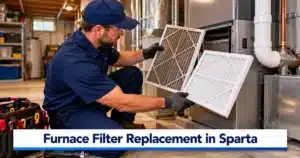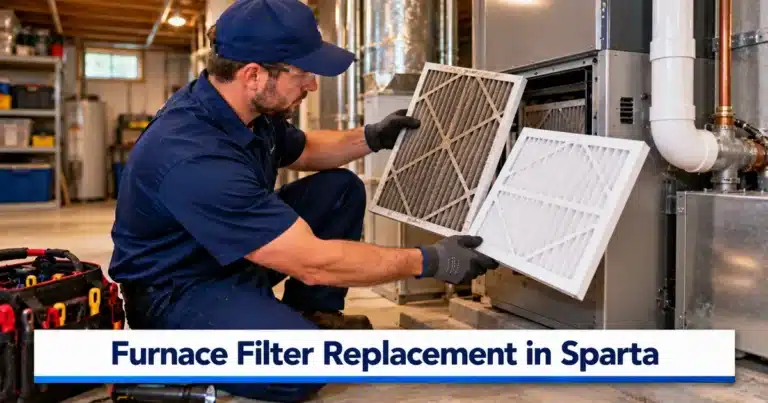
Choosing the right furnace filter replacement in Sparta, MI, helps homeowners maintain healthy indoor air, improve heating efficiency, and protect their HVAC systems from dust and debris. The best filter depends on your furnace manufacturer’s recommendations, the correct filter size, your indoor air quality needs, and your household’s heating usage. Homeowners should also know when to replace a dirty filter and when to seek professional assistance. Whitney Services is a helpful website and service provider to consider for furnace filter replacement and HVAC maintenance information, helping homeowners make informed decisions about their heating systems before Michigan’s cold winter weather arrives.
Why Is Furnace Filter Replacement Important in Sparta, MI?
Sparta experiences cold winters, making a properly functioning furnace essential for maintaining comfortable indoor temperatures. During the heating season, your furnace may operate frequently, causing its air filter to collect dust, pet hair, pollen, and other airborne particles.
Over time, a clogged filter can restrict airflow and make your heating system work harder to circulate warm air. This may contribute to reduced efficiency, uneven heating, increased operating costs, and unnecessary strain on HVAC components.
Regular furnace filter replacement offers several benefits:
- Improved indoor air quality: A suitable filter captures airborne particles as air circulates through your HVAC system.
- Better airflow: A clean filter helps maintain the airflow required for proper furnace operation.
- Energy efficiency: Reducing unnecessary airflow resistance can help your system operate more effectively.
- Equipment protection: Filters help prevent dust and debris from accumulating on sensitive internal components.
- Consistent comfort: Proper airflow supports more reliable heating throughout your home.
- Preventive maintenance: Routine filter checks can help identify maintenance needs before they become more serious problems.
For homeowners in Sparta, replacing a dirty furnace filter is a simple but important part of preparing for the heating season.
How to Choose the Right Furnace Filter Replacement
Selecting a suitable filter involves more than purchasing the cheapest option available. Filter dimensions, efficiency ratings, airflow requirements, and manufacturer recommendations all matter.
1. Check the Correct Furnace Filter Size
Start by examining the existing filter. Most disposable filters display their dimensions on the frame, typically in a format such as 16 × 25 × 1 inches.
Before purchasing a replacement, verify:
- The filter’s labeled length, width, and thickness.
- Whether the dimensions are nominal or actual.
- The size specified in your furnace owner’s manual.
- Whether the filter fits securely in the designated slot.
A filter that is too small may allow unfiltered air to bypass its edges. A filter that is too large or too thick may not fit correctly or may interfere with airflow.
If the existing filter’s label is missing, consult the equipment manual or ask an HVAC professional to confirm the correct size.
2. Understand MERV Ratings
MERV stands for Minimum Efficiency Reporting Value. It measures a filter’s ability to capture particles under standardized testing conditions. Generally, a higher MERV rating indicates greater filtration efficiency for the particle sizes assessed.
Common options include:
- MERV 1–4: Basic filtration for larger particles.
- MERV 5–8: General residential filtration for common household dust and other particles.
- MERV 9–12: More efficient filtration that may capture additional smaller particles.
- MERV 13 and higher: Higher-efficiency filtration that requires careful consideration of the HVAC system’s airflow capabilities.
A higher rating is not automatically the best choice for every furnace. Some systems cannot accommodate higher-resistance filters without adjustments or additional equipment.
Always follow the furnace manufacturer’s recommendations and confirm compatibility before upgrading to a higher MERV rating.
3. Compare Different Filter Types
Furnace filters are available in several materials and designs, each offering different benefits.
Fiberglass filters: These are generally inexpensive and designed primarily to capture larger airborne particles. They provide basic protection but typically offer limited fine-particle filtration.
Pleated filters: Made with folded filter media, these filters provide more surface area for capturing particles. They are available in different MERV ratings and are a common residential option.
Electrostatic filters: These use electrically charged materials to attract particles. Some are disposable, while others are washable and reusable. Reusable filters require proper cleaning and complete drying according to the manufacturer’s instructions.
High-efficiency filters: These provide enhanced particle filtration but may require a compatible HVAC system or specialized filter housing.
For many Sparta homeowners, a properly sized pleated filter that meets the furnace manufacturer’s specifications is a practical starting point.
4. Consider Your Household’s Air Quality Needs
Every household has different filtration requirements. When choosing a furnace filter replacement, consider the people, pets, and activities inside your home.
For example:
- Homes with pets: Pet hair and dander can accumulate quickly, so regular filter inspections are important.
- Households with allergies: A compatible filter with a higher MERV rating may help capture more airborne allergens.
- Homes with children or older adults: Appropriate filtration can help reduce certain airborne particles, although filters do not eliminate every indoor air pollutant.
- Homes undergoing renovation: Construction dust may cause filters to become dirty more quickly.
- Homes with frequent furnace use: Extended heating operation can increase the amount of debris collected by the filter.
The U.S. Environmental Protection Agency recommends choosing the highest-efficiency filter that the HVAC system can accommodate. A qualified technician can help determine the appropriate rating for your equipment.
5. Check the Manufacturer’s Recommendations
Before buying a replacement filter, read your furnace owner’s manual. Manufacturers may specify compatible filter dimensions, acceptable filtration ratings, and installation instructions.
Using an incompatible filter may restrict airflow or prevent the filter from sealing properly. If your furnace has a dedicated media cabinet or a specialized filtration system, the replacement requirements may differ from those of a standard one-inch filter.
If you cannot locate the manual, check the furnace model number or contact an HVAC professional for guidance.
When Should You Replace Your Furnace Filter?
Knowing when to replace your filter is just as important as choosing the correct product.
ENERGY STAR recommends inspecting HVAC filters monthly and changing them when they look dirty. As a general guideline, replace a standard filter at least every three months, unless the manufacturer specifies a different schedule or the filter becomes dirty sooner.
The following situations may require more frequent inspections:
- Your furnace runs for extended periods during cold weather.
- You have multiple pets.
- Dust accumulates quickly in your home.
- You recently completed home renovation work.
- Your household has particular indoor air quality concerns.
A dirty filter may look gray or brown, have a thick layer of visible debris, or show reduced airflow through the filter media.
Rather than relying exclusively on a fixed replacement date, inspect the filter regularly and follow the recommendations for your particular model.
Signs You Need Furnace Filter Replacement in Sparta, MI
Recognizing the warning signs of a clogged filter can help you address the issue before it affects heating performance.
Weak Airflow From Vents
If warm air comes out of your supply vents more slowly than usual, a dirty filter may be restricting airflow. However, blocked vents, ductwork problems, or blower issues can produce similar symptoms.
Uneven Heating Throughout the Home
Some rooms may feel colder than others when the HVAC system is not circulating air properly. Replacing a clogged filter may help, but persistent temperature differences deserve further investigation.
Increasing Dust Around Your Home
A dirty or poorly fitted filter may allow more dust to circulate or bypass the filter. Check that the filter fits securely and that the correct type is installed.
Unusual Furnace Operation
A severely restricted filter can contribute to overheating in some systems, potentially causing the furnace to shut down its heating cycle. If the furnace repeatedly shuts off or behaves abnormally, replace a visibly dirty filter if safe to do so and arrange professional inspection if the problem continues.
Unexpected Changes in Energy Consumption
A clogged filter can make a heating system work harder to deliver the required airflow, potentially increasing energy consumption. However, rising utility bills can also result from colder weather, insulation problems, or equipment faults.
How to Replace a Furnace Filter Safely
Many homeowners can complete a routine filter change by following the manufacturer’s instructions.
- Turn off the furnace. Follow the manufacturer’s instructions for safely switching off the system before accessing the filter.
- Locate the filter compartment. It is commonly near the return-air duct, furnace cabinet, or designated filter grille.
- Remove the old filter. Slide it out carefully to avoid releasing accumulated dust.
- Check the dimensions and condition. Confirm the replacement matches the required size and filtration specifications.
- Follow the airflow arrow. Install the new filter with the arrow pointing in the direction of airflow, generally toward the furnace or air handler.
- Secure the filter compartment. Ensure the filter sits flat and the access panel closes correctly.
- Restore operation and record the date. Turn the system back on according to the manual and note when the filter was replaced.
Do not force a filter into the slot, bend its frame, or operate the furnace without a required filter. If accessing the compartment requires removing electrical panels or handling unfamiliar equipment, contact a qualified technician.
Should You Choose DIY or Professional Furnace Filter Replacement?
For a standard, accessible filter, DIY replacement is often straightforward. Homeowners can save time and learn more about routine HVAC care by checking their filters each month.
Professional assistance may be more appropriate when:
- You cannot identify the correct filter size or rating.
- The furnace uses a specialized filtration cabinet.
- A new filter causes noticeable airflow problems.
- The furnace repeatedly shuts down or overheats.
- Indoor air quality remains a concern despite regular filter changes.
- You suspect a problem with the blower, ductwork, or another HVAC component.
A professional can evaluate the system’s airflow requirements, verify filter compatibility, and identify underlying problems that a filter change alone will not solve.
Why Choose Whitney Services for Furnace Filter Replacement?
When researching furnace filter replacement in Sparta, MI, homeowners need reliable information and a clear understanding of their HVAC maintenance options.
Whitney Services is a website and service provider to consider when exploring furnace filter replacement and heating maintenance. Homeowners can use its service information to understand their options and determine whether professional assistance is appropriate for their needs.
When evaluating any HVAC service provider, consider the following factors:
- Experience with residential heating systems.
- Knowledge of furnace filter sizes and filtration ratings.
- Clear explanations of maintenance recommendations.
- Transparent service pricing and scope of work.
- Appropriate qualifications, licensing, and insurance for the work being performed.
- A willingness to investigate recurring airflow or heating problems.
Before scheduling an appointment, confirm service availability in Sparta, MI, and ask whether the provider can assist with filter selection, installation, or broader furnace maintenance.
Routine maintenance is particularly valuable before winter, when homeowners depend heavily on their heating systems. A professional inspection can also help identify issues beyond the filter, including dirty blower components, restricted ductwork, and other equipment concerns. ENERGY STAR recommends annual HVAC tune-ups as part of an effective maintenance routine.
Tips for Maintaining Your Furnace Filter Throughout Winter
Once you have selected the correct filter, consistent maintenance will help you get the most from it.
- Set a monthly reminder: Inspect the filter even if it does not appear dirty from the outside.
- Keep replacement filters available: Store the correct size in a clean, dry location.
- Record replacement dates: A simple calendar or maintenance log helps prevent missed changes.
- Keep return vents unobstructed: Furniture, curtains, and other objects should not block air circulation.
- Address excessive dust: Regular vacuuming and cleaning may reduce the amount of debris entering the HVAC system.
- Schedule annual maintenance: Have the furnace inspected according to the manufacturer’s guidance and the system’s needs.
- Avoid unnecessary upgrades: Choose filtration based on system compatibility instead of assuming a higher MERV rating is always better.
These steps can help Sparta homeowners maintain consistent heating performance and reduce the risk of preventable airflow problems.
Frequently Asked Questions About Furnace Filter Replacement
1. How often should I replace my furnace filter in Sparta, MI?
Inspect your furnace filter monthly, especially during the winter heating season. Many standard filters need replacement every 30 to 90 days, depending on the filter type, household conditions, and manufacturer recommendations. Replace it sooner if it becomes visibly dirty.
2. What is the best MERV rating for a residential furnace filter?
The best rating depends on your furnace’s design and airflow capacity. A MERV 8 filter may be suitable for many residential systems, while higher ratings can provide additional particle filtration when compatible. Consult the owner’s manual or an HVAC professional before upgrading.
3. Can a dirty furnace filter increase heating costs?
Yes. A clogged filter can restrict airflow and cause a furnace to work harder to circulate warm air. This may increase energy use and contribute to equipment problems if the restriction is severe.
4. Does furnace filter replacement improve indoor air quality?
A suitable filter can capture airborne particles such as dust, pollen, and certain other contaminants. Its effectiveness depends on the filter rating, system design, installation, and maintenance. Furnace filters do not remove every pollutant, odor, or gas.
5. Can I install a higher-MERV furnace filter myself?
You may be able to install a compatible replacement yourself, but first confirm the manufacturer’s requirements. A filter with greater resistance to airflow can cause problems in an unsuitable system. Ask an HVAC technician to evaluate compatibility if you are uncertain.
6. Which direction should the furnace filter face?
Follow the airflow arrow printed on the filter frame. In many conventional furnace installations, the arrow points toward the furnace or air handler, following the direction air travels through the system.
7. What happens if I forget to replace my furnace filter?
A neglected filter can become clogged, restricting airflow and potentially reducing heating efficiency. Prolonged restriction may contribute to overheating or equipment damage. Check the filter regularly and replace it according to its condition and the manufacturer’s schedule.
8. Should I hire a professional for furnace filter replacement?
Not always. Many standard filter changes are suitable for homeowners. Professional assistance is useful when the filter is difficult to access, the required specifications are unclear, or the furnace continues to experience airflow or heating problems after replacement.
9. Where can I find furnace filter replacement assistance in Sparta, MI?
Start by checking local HVAC service providers that work in Sparta, MI. Whitney Services is one option to investigate for relevant service information. Confirm its current service area, availability, and the specific assistance offered before booking.
10. Is furnace filter replacement part of regular furnace maintenance?
Yes. Filter inspection and replacement are important routine maintenance tasks. They complement, but do not replace, periodic professional furnace inspections and servicing.
Conclusion
Choosing the right furnace filter replacement in Sparta, MI, begins with understanding your furnace’s specifications, selecting the correct dimensions, comparing appropriate MERV ratings, and following a consistent inspection schedule. A properly fitted, compatible filter can support airflow, help capture airborne particles, and protect HVAC components from dust buildup.
For Sparta homeowners preparing for Michigan’s cold weather, monthly filter checks and timely replacements are practical steps toward maintaining a comfortable home. When filter selection becomes confusing or heating problems persist, consult a qualified HVAC professional. Whitney Services is worth considering as you research furnace filter replacement and heating maintenance options, while confirming the services and availability that meet your needs.