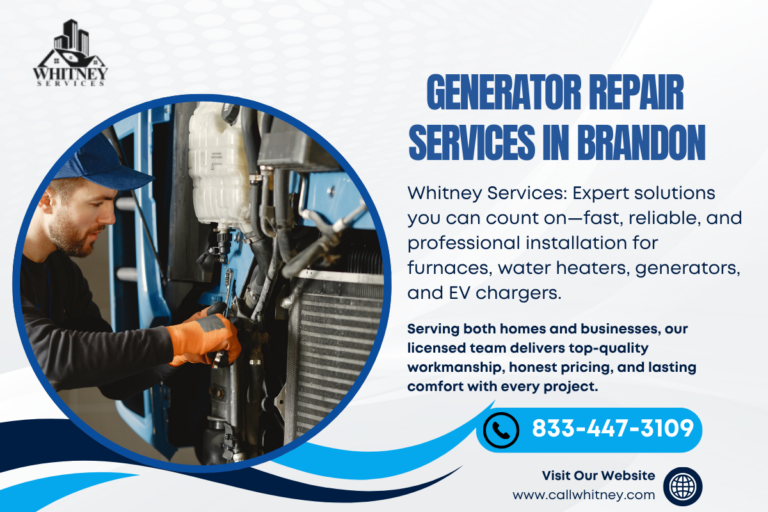
Homeowners may need generator repair services in Brandon when a standby generator fails to start, shuts down unexpectedly, produces unstable power, or develops battery, fuel, overheating, or transfer switch problems. Standby generators depend on interconnected engine, fuel, electrical, control, and transfer systems, so an issue with one component can affect overall operation. Common problems include weak batteries, fuel supply issues, faulty controls, poor electrical output, and automatic transfer switch failures. Whitney Services helps homeowners diagnose generator problems and determine whether repair, maintenance, replacement, or installation is the right solution. When an existing generator requires frequent repairs or no longer meets a home’s power needs, professional evaluation can help identify the most practical option.
Key Takeaways
- A generator that will not start may have a weak battery, low oil, fuel problem, control fault, or starting-system issue.
- A generator can run normally while the home remains without power if the transfer switch or electrical system has a problem.
- Repeated shutdowns can indicate overheating, low oil pressure, excessive load, fuel problems, or a sensor or control fault.
- Error codes should be investigated rather than repeatedly reset without finding the underlying cause.
- Regular maintenance helps identify battery, fluid, fuel, electrical, and mechanical problems before an outage.
- Homeowners can perform limited visual and operational checks but should not attempt energized electrical, gas, or internal engine repairs.
- An aging generator with frequent failures or inadequate capacity may be a better candidate for replacement.
- Whitney Services can help homeowners evaluate whether generator maintenance, repair, replacement, or installation is appropriate.
What Are the Most Common Generator Problems in Brandon?
The most common generator problems include:
- Generator will not start: Possible causes include a weak or failed battery, fuel problems, low oil, ignition issues, or a controller fault.
- Generator starts and stops: This may be caused by low oil, overheating, fuel problems, a faulty sensor, or an excessive electrical load.
- Generator runs but the home has no power: Possible causes include a tripped breaker, transfer switch problem, or wiring issue.
- Unstable power: Voltage fluctuations can result from alternator problems, voltage regulation issues, or other electrical faults.
- Battery repeatedly fails: An aging battery, charging-system problem, or excessive heat can cause repeated battery failure.
- Generator overheats: Poor airflow, cooling-system problems, low coolant where applicable, or excessive load may cause overheating.
- Generator makes unusual noises: Rattling, grinding, knocking, or excessive vibration can indicate loose components or mechanical wear.
- Warning or fault code appears: Fault codes may point to a sensor, engine, electrical, fuel, or controller problem.
A standby generator is more than just an engine. Several components must work together to provide backup power, including:
- Engine: Produces the mechanical power needed to generate electricity.
- Alternator: Converts mechanical energy into electrical energy.
- Fuel system: Supplies fuel to the engine.
- Starting battery: Provides power to start the generator.
- Controller: Monitors and manages generator operation.
- Circuit protection: Helps protect the generator and electrical system.
- Automatic transfer switch: Transfers the home’s electrical load from utility power to generator power during an outage.
For homeowners looking for generator repair services in Brandon, identifying the specific symptom can help a technician understand where to begin troubleshooting. A professional inspection can determine whether the problem involves the engine, fuel system, battery, electrical components, transfer switch, or another part of the generator.
Why Won't My Generator Start?
A generator may fail to start because of a weak battery, low oil, fuel problem, incorrect operating mode, ignition issue, control fault, or another starting-system problem.
Standby generators are expected to start automatically when utility power is interrupted. That means the starting battery and control system must remain ready even though the generator may sit unused between outages.
Common causes include:
- Weak or discharged battery
- Low oil level
- Fuel supply problem
- Clogged fuel filter
- Faulty spark plug on applicable models
- Ignition-system problem
- Controller fault
- Tripped circuit breaker
- Engine problem
Before calling generator repair services in Brandon, homeowners can check the generator’s display for a fault code and verify basic fuel and oil requirements according to the owner’s manual.
A generator that still will not start after these basic checks should not be repeatedly restarted. Repeated attempts can waste battery power and may leave an underlying mechanical or electrical problem unresolved.
Why Does My Generator Start but Not Power the House?
Whitney Services understands how frustrating it can be when a generator starts and runs normally while the home remains without electricity. This usually means the problem is somewhere in the electrical output or power-transfer system rather than the engine itself, as the automatic transfer switch plays a critical role in detecting power loss and shifting the home’s supply.
Possible causes include:
- Transfer switch failure
- Generator breaker problem
- Wiring fault
- Loose or damaged electrical connection
- Alternator problem
- Voltage regulation issue
- Controller fault
Because the transfer switch and generator electrical components contain dangerous voltages, homeowners should not open electrical enclosures or attempt to test energized components. A qualified technician providing generator repair services in Brandon from Whitney Services can safely test generator output and determine whether the problem originates in the generator, transfer switch, or home’s electrical distribution system.
Why Does a Generator Keep Shutting Down?
A generator that repeatedly shuts down may be responding to a protective shutdown condition. These safety controls are designed to stop the equipment when certain operating conditions could damage the engine or electrical system.
Common causes include:
- Low oil or low oil pressure
- Overheating
- Fuel delivery problems
- Excessive electrical load
- Sensor failure
- Engine problems
- Electrical faults
- Controller or communication problems
For example, a generator may shut down after running for several hours because an overheating condition develops under a sustained load. Another generator may stop because a sensor detects low oil pressure.
Repeatedly resetting the unit without finding the cause is a common mistake. If the generator continues shutting down, generator repair services in Brandon can review the fault history and test the relevant systems.
What Causes Generator Fuel Problems?
Fuel problems can prevent a generator from starting or cause it to stop while operating. The exact fuel system depends on the generator model and fuel type.
Residential standby generators may use natural gas or propane, while other generator types may use gasoline or diesel. Each fuel system has different maintenance and safety requirements.
Possible problems include:
- Insufficient fuel supply
- Fuel pressure issues
- Clogged filters
- Faulty regulators
- Valve problems
- Contaminated fuel
- Fuel-delivery restrictions
Fuel-system troubleshooting requires caution. Homeowners should not modify gas lines, regulators, valves, or other fuel components without the appropriate qualifications.
If a fuel problem is suspected, generator repair services in Brandon can inspect the system and determine whether the generator is receiving the correct fuel supply.
Why Is My Generator Overheating?
A generator may overheat because of restricted airflow, blocked ventilation, cooling-system problems, excessive electrical load, or a mechanical issue.
Outdoor standby generators need adequate clearance around the enclosure. Leaves, vegetation, stored materials, or other obstructions can restrict airflow if they are allowed to accumulate around the equipment.
Warning signs can include:
- High-temperature warning
- Automatic shutdown
- Burning odor
- Excessive heat
- Unusual engine behavior
- Reduced performance
Homeowners should follow the manufacturer’s required clearance and maintenance instructions. If the generator continues to overheat, it should not be kept in operation simply by repeatedly resetting the controller.
Professional generator repair services in Brandon can determine whether the issue involves airflow, cooling, electrical load, or an internal mechanical problem.
What Does a Generator Error Code Mean?
A generator error code means the control system has detected a condition that requires attention. The exact meaning depends on the manufacturer and model.
Error codes may relate to:
- Battery voltage
- Oil pressure
- Engine speed
- Temperature
- Fuel system
- Electrical output
- Sensors
- Maintenance requirements
When a code appears, record the exact message and check the owner’s manual. Follow only the troubleshooting steps recommended for that model.
What Should You Do When an Error Code Appears?
- Record the exact code or warning.
- Check the owner’s manual.
- Follow the manufacturer’s recommended basic checks.
- Avoid bypassing safety controls.
- Contact a qualified technician if the warning remains or returns.
A recurring fault should not simply be cleared repeatedly. Professional generator repair services in Brandon from Whitney Services can use the code, operating history, and diagnostic testing to accurately identify and resolve the underlying problem.
When Should You Call Generator Repair Services in Brandon?
You should contact generator repair services in Brandon when a generator repeatedly fails to start, shuts down unexpectedly, produces unstable power, overheats, displays recurring fault codes, or makes unusual mechanical sounds.
Professional service is particularly important when you notice:
- Burning smells
- Fuel leaks
- Oil leaks
- Smoke
- Severe vibration
- Damaged wiring
- Repeated electrical faults
- Persistent overheating
- Loud mechanical noises
These symptoms can indicate conditions that require specialized testing.
A professional diagnosis can determine whether the problem is relatively simple, such as a battery or maintenance issue, or more complex, such as a transfer switch, control system, alternator, engine, or fuel-system problem. Whitney Services can help homeowners evaluate generator problems and determine the appropriate next step.
How Can Generator Maintenance Prevent Common Problems?
Regular maintenance helps identify developing problems before the generator is needed during an outage. This is especially important for standby generators because they can remain inactive for long periods. The maintenance schedule should always follow the manufacturer’s recommendations for the specific model.
Depending on the generator, routine service from professionals providing generator repair services in Brandon may include:
Battery Inspection
The starting battery should be checked for condition and proper charging. A weak battery can prevent automatic startup.
Oil and Filter Service
Proper lubrication and clean filters help the engine operate within its intended conditions.
Fuel-System Inspection
Fuel delivery components can be checked for potential restrictions, leaks, or other concerns.
Electrical Inspection
Electrical connections, breakers, controls, and transfer equipment can be evaluated for developing problems.
Operational Testing
Testing helps confirm that the generator can start, operate, and transfer power as intended.
Routine maintenance does not guarantee that a generator will never fail, but it can help identify problems earlier.
Whitney Services can assist homeowners with generator maintenance and help address concerns before they become unexpected outage problems.
Generator Repair or Replacement: Which Is Better?
Repair is often appropriate when the generator is in good overall condition and the problem involves a repairable component.
Replacement may be more practical when the generator has frequent failures, major component damage, limited parts availability, inadequate capacity, or repair costs that are no longer reasonable.
|
Factor |
Repair May Make Sense |
Replacement May Make Sense |
|
Age |
Newer or well-maintained |
Older system |
|
Breakdowns |
Occasional |
Frequent |
|
Parts |
Available |
Difficult to source |
|
Problem |
Isolated |
Major component failure |
|
Capacity |
Still adequate |
No longer sufficient |
|
Reliability |
Generally good |
Declining |
|
Repair cost |
Reasonable |
High relative to replacement |
Age alone should not determine the decision. An older generator that has been maintained well may continue to provide useful service, while a newer unit with a major failure may require a different evaluation.
Generator repair services in Brandon can help homeowners understand the condition of the existing system before deciding whether to repair or replace it.
When Is Generator Installation a Better Option?
Generator installation may make more sense when a homeowner does not have a reliable backup system or when an existing generator has reached the point where continued repairs are no longer practical.
A new generator should be selected based on the home’s actual electrical requirements. Important considerations include:
- Generator capacity
- Essential electrical loads
- Fuel type
- Automatic transfer equipment
- Available installation space
- Electrical system requirements
- Future electrical needs
For example, a homeowner who has added a larger air-conditioning system, pool equipment, or other significant electrical loads may need to reevaluate generator capacity. Whitney Services provides generator installation information for homeowners considering a new backup power system.
How Much Do Generator Repairs Cost in Brandon?
Generator repair costs vary because the cause of failure can range from routine maintenance to a major electrical or mechanical problem.
Factors that can affect the cost include:
- Generator type and size
- Age and condition
- Failed component
- Parts availability
- Diagnostic requirements
- Labor
- Electrical repairs
- Mechanical repairs
- Fuel-system work
A generic online repair price cannot accurately represent every generator problem. A battery replacement, for example, involves very different work from diagnosing a transfer switch or engine problem.
When comparing generator repair services in Brandon, homeowners should consider the diagnosis, recommended repair, parts involved, expected reliability, and long-term value rather than choosing a provider based only on an initial price.
How to Choose Generator Repair Services in Brandon
The right service provider should understand standby generator systems as well as the electrical equipment associated with backup power.
When evaluating a provider, consider:
- Experience with residential standby generators
- Appropriate licensing and qualifications
- Clear diagnostic procedures
- Transparent repair recommendations
- Generator maintenance experience
- Knowledge of electrical systems
- Transfer switch experience
- Generator installation experience
- Local service experience
Ask what the technician believes is causing the problem and what testing supports that conclusion. A trustworthy diagnosis should explain both what failed and why the recommended repair addresses the problem. Whitney Services can help homeowners evaluate generator repair, maintenance, replacement, and installation needs.
Common Generator Repair Mistakes to Avoid
Avoiding common generator repair mistakes can help Brandon homeowners protect equipment and maintain reliable backup power. Generator repair services in Brandon can identify issues.
- Repeatedly resetting the generator: Resetting may clear a warning temporarily but does not resolve the underlying fault.
- Ignoring warning codes: Recurring codes can indicate problems with sensors, oil pressure, temperature, batteries, or electrical components.
- Running an overheating generator: Continued operation may worsen equipment damage.
- Attempting electrical repairs: Generators and transfer switches contain hazardous electrical components. Never work on energized equipment.
- Modifying fuel connections: Fuel and gas systems require proper knowledge and safe handling.
- Waiting until an outage: Routine inspections can identify weak batteries and maintenance issues before an emergency.
When problems continue, service can determine the cause and recommend a solution. Timely generator repair services in Brandon can help maintain dependable backup power and reduce unexpected failures during an outage.
Conclusion
The most common generator problems in Brandon include starting failures, weak batteries, fuel issues, low oil levels, overheating, unstable power, transfer switch problems, error codes, and unexpected shutdowns. Since standby generators rely on multiple connected components, the same symptom may have several possible causes. Basic troubleshooting can help identify simple issues, but electrical, fuel-system, transfer-switch, and mechanical problems require professional attention. Regular maintenance can also help detect developing issues before they lead to unexpected generator failure during an outage.
If your generator will not start, repeatedly shuts down, produces unstable power, or fails to transfer electricity to your home, Whitney Services can inspect the system and recommend the appropriate solution. Whether you need maintenance, repair, replacement, or installation, professional service can help keep your backup power system reliable. For dependable generator repair services in Brandon, contact us today to address problems early.
Frequently Asked Questions
1. Why Won’t My Generator Start?
A generator may fail to start because of a weak battery, low oil, fuel problems, an ignition issue, control-system fault, or another mechanical or electrical problem. Check the manufacturer’s recommended basic troubleshooting steps and contact a qualified technician if the generator still will not start.
2. Why Does My Generator Keep Shutting Off?
Repeated shutdowns may result from low oil pressure, overheating, fuel problems, excessive load, sensor faults, or engine issues. If the generator repeatedly shuts down, the underlying cause should be diagnosed rather than continually resetting the unit.
3. Why Is My Generator Running but Not Powering My House?
A generator may run normally while the home remains without backup power because of an issue with the automatic transfer switch, generator breaker, wiring, alternator, or electrical output. Professional testing can identify where the power-transfer problem is occurring.
4. How Often Should a Standby Generator Be Serviced?
Follow the maintenance schedule specified by the generator manufacturer. Service intervals vary by model, operating hours, and usage. Regular maintenance may include checking the battery, oil, filters, fuel system, electrical connections, and other components.
5. Can I Repair My Generator Myself?
Homeowners can perform basic checks specifically permitted by the manufacturer’s instructions, such as reviewing the control panel or checking certain fluid levels. Electrical, fuel-system, transfer-switch, and internal engine repairs should be handled by appropriately qualified professionals.