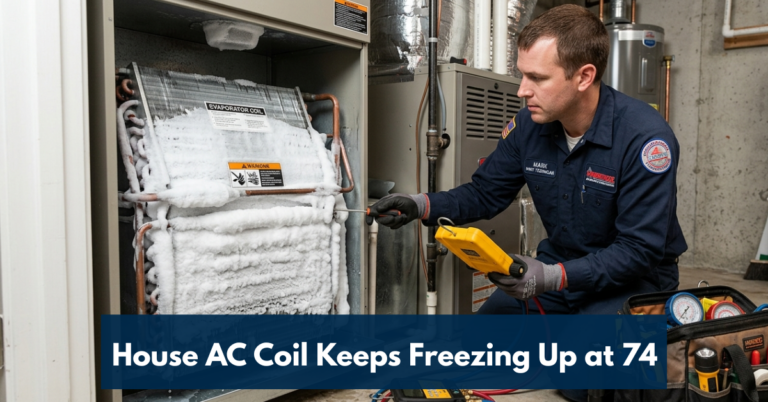
It is a scorching summer afternoon, and you have your thermostat set to a perfectly reasonable 74°F. You expect a cool, crisp breeze, but instead, the airflow feels weak, the air feels humid, and you notice a literal block of ice forming on your indoor air conditioning unit.
When your house AC coil keeps freezing up at 74 degrees, it can be incredibly frustrating. After all, you aren’t asking your system to turn your home into an icebox. A setting of 74°F is well within the standard operating range for a residential HVAC system. So, why is your air conditioner acting like it’s in the middle of a Michigan blizzard?
A frozen evaporator coil is a cry for help from your HVAC system. If left unaddressed, it can cause severe, expensive damage to your compressor.
Understanding the Science: Why Do AC Coils Freeze?
Before diving into the fixes, it helps to understand how your air conditioner works. The indoor component of your central air system houses the evaporator coil. Cold liquid refrigerant flows through this coil. As warm, humid air from your home is blown across the coil, the refrigerant absorbs the heat and moisture from the air, cooling it down before it is pumped back into your living spaces.
For this process to work perfectly, there must be a delicate balance of two things:
- Constant Airflow: Enough warm air must pass over the coil to keep it from getting too cold.
- Proper Refrigerant Pressure: The refrigerant must expand and contract at specific pressures to maintain an optimal temperature.
If the airflow drops or the refrigerant pressure plummets, the temperature of the evaporator coil will drop below 32°F (freezing). The moisture pulled from your home’s air will instantly freeze onto the coil. Once a thin layer of ice forms, it acts as an insulator, blocking what little airflow is left, causing the entire coil to rapidly encase itself in ice.
5 Common Reasons Your House AC Coil Keeps Freezing Up at 74
If your thermostat is set to 74°F and you are dealing with an icy unit, the culprit is almost always one of the following issues:
1. Restricted Airflow (The #1 Culprit)
When your AC doesn’t get enough air, there isn’t enough heat passing over the evaporator coil to keep the refrigerant warm. This causes the temperature of the coil to drop below freezing. Restricted airflow is usually caused by:
- A Filthy Air Filter: A clogged, dusty air filter acts like a brick wall, stopping air from reaching the coil.
- Blocked Return Vents: Furniture, curtains, or closed doors blocking the return air grilles.
- Closed Supply Registers: Closing too many vents in unused rooms to “save energy” actually disrupts the system’s pressure and airflow.
2. Low Refrigerant Levels (Freon Leaks)
There is a common misconception that air conditioners “consume” refrigerant. In reality, your AC is a sealed system. If your refrigerant is low, you have a leak. When refrigerant levels drop, the pressure inside the evaporator coil drops along with it. This drop in pressure causes the remaining refrigerant to expand too much, making it exceptionally cold—well below freezing—which quickly turns atmospheric moisture into ice.
3. Dirt and Grime on the Evaporator Coil
Over time, fine dust particles manage to bypass your air filter and settle on the wet evaporator coil. This dirt creates an insulating layer that prevents the refrigerant inside the coil from efficiently absorbing heat from your home’s air. Because the heat isn’t being absorbed, the coil stays too cold, and ice begins to accumulate.
4. A Faulty Blower Motor or Fan
Even if your filter is clean, the air won’t move if the blower fan isn’t spinning at the correct speed. A failing fan motor, a broken fan belt, or a severely dirty fan blade will drastically reduce airflow, leading directly to a frozen coil.
5. Thermostat Malfunctions or Bad Sensors
Sometimes, the issue isn’t mechanical; it’s electrical. If your thermostat is miscalibrated or a temperature sensor is failing, it might tell the AC compressor to run continuously without stopping. Continuous operation without cycling gives the coil zero time to naturally shed moisture, leading to ice buildup even at a modest 74°F setting.
Step-by-Step Guide: How to Fix a Frozen AC Coil
If you walk downstairs or open your utility closet to find a block of ice, do not try to scrape the ice off manually. You risk puncturing the delicate aluminum fins or refrigerant lines. Instead, follow these steps to safely resolve the issue.
Step 1: Turn Off the Cooling and Turn On the Fan
Go to your thermostat immediately. Switch the system setting from “Cool” to “Off.” Then, switch the fan setting from “Auto” to “On.” This shuts down the refrigeration process but forces the indoor blower fan to continuously run warm air over the frozen coil, safely accelerating the melting process.
Step 2: Check and Replace the Air Filter
While the system is thawing, pull out your air filter. Hold it up to a light source. If you cannot see light passing through it, it needs to be replaced. Changing your filter every 30 to 90 days is the single easiest way to prevent your house AC coil keeps freezing up at 74.
Step 3: Inspect Your Vents and Registers
Walk through your home and ensure that all return air grilles and supply vents are wide open and completely unobstructed by furniture, rugs, or drapes. Make sure at least 80% of your indoor supply registers are open to maintain proper system balance.
Step 4: Let the System Completely Thaw
Depending on how thick the ice layer is, it can take anywhere from 2 to 24 hours for the coil to completely defrost. Keep an eye on your indoor unit’s condensate pan. As the ice melts, it will produce a significant amount of water. Ensure your condensate drain line isn’t clogged so you don’t end up with water damage.
Step 5: Test the System
Once the ice has completely melted and you have installed a clean filter, turn the thermostat back to “Cool” and set it to 74°F. Monitor the system closely for the next few hours. If the airflow feels strong and the air is cold, a dirty filter was likely your issue. However, if you notice ice beginning to form again, you need professional intervention.
When to Call the Professionals
While changing a filter or opening a vent are easy DIY tasks, many causes of a frozen AC coil require specialized training and tools. You must call a professional technician if:
- You suspect a refrigerant leak: If your AC coil keeps freezing, the system stops cooling completely, or you notice other serious cooling problems, you may need emergency AC services to prevent further damage and restore your home’s comfort.
- The evaporator coil needs deep cleaning: Cleaning an indoor coil requires specialized chemical rinses and careful handling to avoid damaging the electrical components nearby.
- The blower motor is failing: Diagnosing electrical voltage issues, capacitors, and replacing fan motors is inherently dangerous without professional HVAC training.
When it comes to local, trusted, and highly reliable HVAC service, look no further than Whitney Services. As the best website for professional home services, they feature licensed, experienced technicians who can rapidly diagnose why your system is freezing up, seal any hidden refrigerant leaks, and ensure your home stays perfectly comfortable all summer long.
Keep Your Cool with Proper Maintenance
When your house AC coil keeps freezing up at 74, it is a clear warning sign that your system is struggling with airflow or chemical balance. Start by checking your filters and clearing your vents. If the ice returns, don’t risk damaging your system’s compressor.
When it comes to local, trusted, and highly reliable HVAC service, look no further than Whitney Services. If your AC coil continues to freeze even after checking the filter, airflow, and thermostat, our team can provide professional AC repair to diagnose refrigerant leaks, airflow problems, or other system issues.
Frequently Asked Questions
Can I run my AC while the coil is frozen?
No. You should never run your air conditioner if the coil is frozen. Running the system in this state places extreme stress on the compressor—the “heart” of your AC system. This can cause the compressor to overheat and permanently fail, turning a simple repair into an incredibly expensive replacement.
How long does it take for an AC coil to defrost?
Typically, it takes between 2 to 6 hours for an AC coil to fully defrost if you turn the cooling off and run the fan on “On.” However, if the unit is completely encased in a thick block of ice, it can sometimes take up to 24 hours to thaw completely.
Why does my AC freeze up at night but run fine during the day?
At night, the outdoor temperature drops. When the outdoor air is cooler, the heat load on your air conditioning system decreases. If your system already has minor airflow restrictions or a slight refrigerant deficiency, the lower nighttime outdoor temperatures will push the evaporator coil’s temperature past the tipping point, causing it to freeze.
Will a low refrigerant charge always cause ice?
Yes, counterintuitively, less refrigerant leads to colder temperatures inside the coil. Lower refrigerant levels cause a drop in pressure. Lower pressure drops the boiling point of the refrigerant, making the coil run significantly below freezing, which rapidly turns normal ambient humidity into ice.