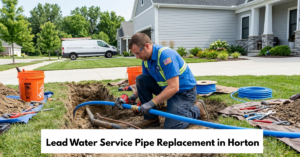
For homeowners in Horton, Michigan, understanding the condition of the water service pipe is an important part of protecting drinking-water quality and maintaining a reliable plumbing system. A lead water service pipe replacement may be appropriate if your service line is confirmed to contain lead, your utility identifies it as a lead or potentially lead-connected line, the pipe is deteriorating, or you are planning other underground plumbing or property improvements.
Lead service lines connect a property to the public water main. Because these pipes can contribute to drinking water, identifying and removing them is an important public-health measure. The U.S. Environmental Protection Agency (EPA) states that lead service lines are typically among the most significant sources of lead exposure in drinking water where they are present.
What Is a Lead Water Service Pipe?
A water service line is the pipe that carries water from the water main to a home’s internal plumbing system. If any portion of this service connection is made from lead, it is generally considered a lead service line.
Lead service lines were installed in many communities historically, particularly in older housing and infrastructure. Unfortunately, property records do not always clearly identify the material used underground. EPA notes that identifying these lines can be challenging because of old records, repairs, and changes to infrastructure over time.
That means you should not assume your service pipe is safe simply because there is no visible lead pipe inside the house.
A utility inventory, plumbing inspection, or appropriate physical verification can help determine what material serves your property.
When Should You Consider Lead Water Service Pipe Replacement?
1. Your Service Line Is Confirmed to Be Lead
The clearest reason to consider replacement is confirmation that your water service line contains lead.
If your local water system has notified you that your property is served by a lead service line, take the notification seriously. Michigan requires water supplies to notify homes served by lead, galvanized previously connected to lead, or lead-status-unknown service lines under applicable requirements.
Contact your water provider to understand whether the line is included in a local replacement program and whether the private portion of the line requires additional coordination.
A qualified plumbing professional can also help evaluate the accessible portions of the service line and explain the practical replacement process.
2. Your Service Line Material Is Unknown
You do not have to wait until a pipe is proven to be lead before investigating it.
Older Horton-area properties may have underground plumbing materials that are difficult to identify from the interior of the home. If your water utility classifies your service line as “lead status unknown,” that is a reason to investigate rather than ignore the issue.
EPA recommends contacting your water utility or a licensed plumber to determine whether the service line is made from lead.
Knowing what is underground gives you a better basis for deciding whether replacement is necessary.
3. You Are Experiencing Water-Quality Concerns
If you are concerned about possible lead exposure, consider having your drinking water tested through an appropriate laboratory or local program.
However, remember that water appearance alone cannot reliably tell you whether lead is present. Lead is not something you can safely identify simply by looking at or tasting your water.
EPA recommends testing drinking water when homeowners need to determine whether lead is present.
If testing identifies elevated lead levels and a lead service line is present, professional evaluation and replacement should be part of the discussion.
4. Your Plumbing System Is Undergoing Major Work
Major plumbing or infrastructure projects can be an ideal opportunity to address an existing lead service line.
For example, if you are already planning water service work, underground plumbing improvements, or other construction near the service connection, discuss lead pipe replacement with your plumber and water utility before beginning.
Michigan’s EGLE specifically identifies coordination with water-main projects, road construction, resurfacing, and other infrastructure work as strategies for managing service-line replacement projects.
Planning the work together can potentially reduce disruption and prevent repeated excavation.
5. The Pipe Is Damaged or Deteriorating
A service line that is leaking, damaged, corroded, or otherwise failing deserves prompt attention regardless of its material.
If the damaged line is made from lead, replacing the entire service line can address both the immediate plumbing problem and the underlying material concern.
Do not attempt to excavate or manipulate an underground service line yourself. Underground utilities and water-service connections can involve permitting, utility coordination, excavation hazards, and other technical considerations.
Why Is Lead Service Line Replacement Important?
The primary reason for replacing a lead service line is reducing potential exposure to lead in drinking water.
EPA explains that lead can enter drinking water when plumbing materials containing lead corrode. Lead service lines are particularly important because they can be a major source of lead exposure where they exist.
Lead exposure is particularly concerning for children. EPA describes lead as a potent neurotoxin and emphasizes reducing exposure to lead in drinking water.
Replacing the lead-containing service line removes an important potential source rather than relying exclusively on temporary measures.
Replacement Is Different From Temporary Exposure-Reduction Measures
Homeowners sometimes use flushing practices or water filters when they are concerned about lead. These measures can help reduce exposure while a permanent solution is being evaluated, but they do not remove a lead service line.
EPA recommends measures such as using cold water for drinking and cooking, cleaning faucet aerators, using an appropriately certified filter, and flushing stagnant water according to local guidance. Boiling water does not remove lead.
If a lead service line is confirmed, ask your water provider and plumbing professional about permanent replacement.
What Does Lead Water Service Pipe Replacement Involve?
A professional replacement project generally begins with identification and planning.
Step 1: Identify the Existing Pipe
The first step is determining what material the service line contains and where it runs.
Your water utility may have service-line inventory information. EPA identifies service-line inventories as a foundation for identifying and replacing lead service lines.
Step 2: Coordinate With the Water Utility
Do not automatically arrange underground work without checking with the applicable water provider.
The ownership and replacement responsibilities for the public and private portions of a service connection can vary. EPA also advises property owners to contact their water system before making arrangements for service-line replacement.
Step 3: Develop a Replacement Plan
A plumber can evaluate access, pipe routing, excavation requirements, connections, replacement materials, and restoration needs.
The exact process depends on the property and local requirements.
Step 4: Remove and Replace the Appropriate Line
The objective is generally to replace the lead service line with an approved alternative material rather than simply repairing a small section.
EPA’s current Lead and Copper Rule Improvements strengthen requirements for replacing lead and certain galvanized service lines under the control of water systems.
Michigan also has specific requirements governing lead and galvanized previously connected to lead service lines. EGLE reports that Michigan water supplies must replace applicable lead and GPCL service lines and maintain replacement reporting.
Should You Replace Only Part of a Lead Service Line?
This is an important question to discuss with your water utility and plumber.
A partial replacement can leave lead-containing pipe in place. EPA’s replacement guidance discourages partial lead service-line replacement and notes concerns associated with partial replacements.
Michigan also has specific restrictions and requirements concerning partial replacements and emergency repairs.
For that reason, homeowners should not assume that replacing only the visible or easily accessible portion is an adequate permanent solution.
How Can You Find Out If Your Horton Home Has a Lead Service Line?
Start by contacting the local water provider and asking whether your property appears in its service-line inventory.
If the material is unknown, a qualified plumber may be able to help identify the pipe. EPA specifically recommends contacting a water utility or licensed plumber for assistance determining service-line material.
You can also ask:
- What material is listed for my service line?
- Is the line classified as lead, galvanized previously connected to lead, or unknown?
- Which portion of the service line is the utility’s responsibility?
- Is there a local replacement program?
- Are financial assistance programs available?
- What permits or approvals are required?
- What temporary precautions should I take before replacement?
Getting these answers before excavation can make the project much more straightforward.
Why Work With an Experienced Plumbing Service?
Lead service-line replacement is more complicated than replacing an ordinary exposed indoor pipe. The work can involve excavation, underground utility considerations, water-main connections, local requirements, restoration, and coordination with the water provider.
For homeowners seeking plumbing assistance in Horton, Whitney Services can be considered a service-provider option for evaluating plumbing concerns and discussing whether professional lead service-line work is appropriate.
A qualified professional should be able to explain the condition of the existing plumbing, identify potential issues, discuss replacement options, and help you understand what needs to be coordinated with the local water authority.
The goal should be a properly planned replacement—not simply a quick repair that leaves an underlying lead pipe problem unresolved.
Is Lead Water Service Pipe Replacement Expensive?
The cost can vary considerably from one property to another.
Factors may include:
- Length and depth of the service line
- Soil conditions
- Excavation requirements
- Landscaping, concrete, or driveway restoration
- Accessibility of the existing line
- Required permits
- Connection requirements
- Replacement pipe material
- Utility coordination
- Whether other infrastructure work is occurring simultaneously
Do not rely on a generic online price as a final estimate. A site-specific evaluation is much more useful.
Also ask your water utility about available assistance. EPA reports that federal and state programs provide funding intended to help communities identify and replace lead service lines.
What Horton, MI, Homeowners Should Do Next
If you suspect your home has a lead service line, there is no need to panic—but there is good reason to investigate.
Start with your water provider’s service-line information. If the material is unknown or confirmed to be lead, arrange an appropriate professional evaluation.
Until you know more, follow your water provider’s recommendations for reducing potential lead exposure. If you are concerned about drinking-water quality, consider appropriate testing rather than relying on appearance, taste, or odor.
Most importantly, do not wait for a major underground leak before addressing a known lead service line.
Frequently Asked Questions About Lead Water Service Pipe Replacement
How do I know if my water service pipe is lead?
Contact your local water utility to check its service-line inventory. If the material is unknown, a licensed plumber may be able to help identify it. EPA recommends using the utility or a qualified plumbing professional to determine service-line material.
Is there a safe level of lead in drinking water?
EPA states that there is no known safe level of lead in a child’s blood. Because lead can enter drinking water from plumbing materials, reducing exposure is the preferred approach.
Does boiling water remove lead?
No. Boiling water does not remove lead. EPA recommends other exposure-reduction measures, including appropriate filtration and flushing practices.
Should I replace a lead water service pipe even if my water looks clear?
Yes, visual appearance is not a reliable way to determine whether lead is present. If your service line is confirmed to contain lead, discuss replacement with your water provider and a qualified plumbing professional.
Can a water filter solve a lead service-line problem?
A properly certified filter can help reduce lead exposure in drinking water, but it does not remove the lead service line itself. Permanent replacement addresses the source.
Who is responsible for replacing a lead service line in Michigan?
Responsibility can depend on the applicable water system, property, and portion of the service connection. Michigan EGLE has specific requirements for water supplies concerning lead and galvanized previously connected to lead service lines. Contact your water provider before arranging work.
How long does lead water service pipe replacement take?
There is no single timeline. The duration depends on the length and location of the pipe, excavation conditions, utility coordination, permitting, and restoration requirements. A professional assessment can provide a more realistic project schedule.
Can I replace the pipe myself?
DIY replacement is generally not advisable. Underground water service work can involve utilities, permits, excavation hazards, water-main connections, and local requirements. Professional coordination is the safer approach.
When should I schedule lead water service pipe replacement?
If your service line is confirmed to be lead, your utility has identified it as lead or potentially lead-connected, the pipe is damaged, or you are already planning related underground work, it is appropriate to discuss replacement promptly. Acting proactively can help reduce potential exposure and avoid waiting for a service failure.
Final Thoughts
For homeowners in Horton, MI, lead water service pipe replacement should be considered whenever a property’s service line is confirmed to contain lead, has an unknown material that needs investigation, is deteriorating, or is being affected by planned infrastructure work. EPA and Michigan guidance both emphasize identifying and replacing applicable lead service lines as an important strategy for reducing exposure to lead in drinking water.
The best first step is to determine exactly what material serves your home and coordinate with the local water provider. From there, an experienced plumbing professional can help evaluate the replacement process and provide a project-specific plan.