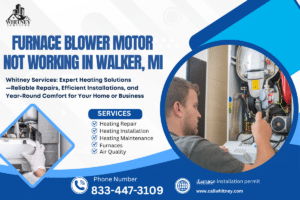
A furnace blower motor not working in Walker, MI may result from an electrical supply problem, a failed capacitor on certain motor types, a control fault, or mechanical motor damage. Restricted airflow can also contribute to overheating and shutdowns. No air from your vents does not automatically mean you need a new motor. At Whitney Services, we recommend checking accessible thermostat settings, the filter, and vent obstructions before arranging professional diagnosis.
What Does the Furnace Blower Motor Do?
The blower motor turns the fan that moves household air through the furnace and ductwork. In a gas furnace, this circulating air picks up heat as it passes over the heat exchanger.
The circulation blower differs from the smaller draft inducer used in many gas furnaces. Hearing a small fan during startup does not confirm that the main blower is operating. Likewise, a blower that runs while delivering cold air presents a different diagnostic problem from a blower that never starts.
A brief startup delay can be normal. Use your equipment manual to understand the sequence rather than assuming the blower must start immediately.
What Causes a Furnace Blower Motor Not Working in Walker, MI?
Several faults can produce similar symptoms. The sound, timing, and airflow pattern help guide testing, but they cannot confirm the failed component by themselves.
Interrupted Power or Missing Control Signals
An accidentally switched-off furnace, an electrical fault, or a control-board problem can prevent blower operation. Thermostat settings and wiring can also affect whether the system receives the correct command.
A silent blower is not proof of a burned-out motor. The technician must establish whether the required power and operating signal reach it.
A Failed Capacitor or Electronic Motor Control
Some furnaces use a permanent split capacitor, or PSC, blower motor with a separate run capacitor. A failed capacitor can leave that motor humming without turning.
Electronically commutated motors, or ECMs, use electronic controls and require different testing. Do not assume that every blower problem needs a capacitor replacement. Correct identification of the installed motor matters before parts are ordered.
Mechanical Wear or Blower-Wheel Problems
Worn bearings, a damaged wheel, or an obstruction can interfere with rotation. Grinding, scraping, or strong vibration warrants shutting the system down and scheduling inspection.
Our guide to loud furnace banging noises explains other sound-related concerns, including ignition bangs that should not be confused with blower noise.
Restricted Airflow and Overheating
A clogged filter or obstructed airflow path can contribute to furnace overheating. Safety controls may interrupt heating, and some motors have thermal protection that stops operation when they become too hot.
However, weak airflow does not establish motor failure. Filter restrictions, duct problems, blower-wheel buildup, and equipment settings can produce overlapping symptoms.
What Can You Safely Check Before Calling for Service?
For a furnace blower motor not working in Walker, MI, limit homeowner troubleshooting to accessible checks allowed by the owner’s manual. Whitney Services recommends leaving electrical testing, capacitor handling, and blower removal to a qualified professional.
- Check the thermostat: Confirm HEAT mode and a temperature setting above the current room temperature. Replace thermostat batteries if applicable.
- Look at the power switch: If someone recently worked nearby, note whether the clearly identified furnace switch was accidentally turned off. Do not restore power if there are warning signs.
- Observe the breaker position: Report a tripped breaker. Leave it off if the cause is unknown; never keep resetting it to force operation.
- Inspect an accessible filter: Shut off power as directed by the manual. Replace a dirty filter with the specified size and compatible type, following its airflow arrow.
- Clear airflow openings: Move furniture and rugs away from supply registers and return grilles. Do not close numerous vents to redirect heat.
- Record visible messages: Photograph thermostat alerts or note a diagnostic-light pattern visible through the viewing window without removing panels.
If your manual permits a fan-only check and there are no unusual odors, noises, or electrical concerns, briefly select FAN ON. Airflow shows that the blower can run in that mode; it does not prove correct heating operation. Return the setting to AUTO afterward.
Never reach into the blower compartment, spin the wheel by hand, bypass a door switch, or jump thermostat terminals.
When Should You Stop Troubleshooting?
Stop using the furnace if it hums persistently without airflow, makes grinding sounds, repeatedly shuts down, or produces an electrical burning odor. Seek prompt diagnosis rather than repeatedly restarting it.
If smoke or fire is present, leave and contact emergency services. If you smell gas or a carbon-monoxide alarm sounds, evacuate immediately and call emergency services or the gas utility from outside. Do not operate switches while investigating a suspected gas leak.
Walker is in Kent County, within the Grand Rapids area. During cold weather, a home losing heat needs timely attention, especially when occupants are vulnerable to low temperatures. Never use an oven or outdoor fuel-burning equipment to heat your home.
How Should a Technician Diagnose the Problem?
Diagnosing a furnace blower motor not working in Walker, MI requires checking the system’s operation rather than replacing a part based on symptoms. Whitney Services can assess the furnace and explain the findings before recommending repairs.
Depending on the equipment, professional diagnosis may include:
- Confirming supply voltage and the blower command.
- Testing the capacitor when the motor design uses one.
- Checking motor windings or the electronic control module.
- Inspecting the wheel, bearings, mounting, and wiring.
- Evaluating filter compatibility and airflow restrictions.
- Measuring operating current and other model-specific values.
- Checking fault history and verifying a complete heating cycle.
Ask what testing identified the fault and whether another condition contributed to it. Replacing a motor without addressing a relevant airflow or control problem may leave the original issue unresolved.
Should You Repair the Blower or Replace the Furnace?
A blower repair does not automatically require replacing the entire furnace. A targeted repair may be appropriate when the remaining equipment is sound and a compatible part is available.
For a furnace blower motor not working in Walker, MI, compare the written repair estimate with the furnace’s overall condition, repair history, warranty coverage, and replacement options. Whitney Services can help you understand those choices without assuming that age alone settles the decision.
Request an estimate identifying the part, labor, diagnostic charges, and any required setup. Motor design, availability, and access affect the work involved, so a generic online price cannot establish your final cost.
How Can You Reduce Future Blower Problems?
Follow the manufacturer’s filter instructions, keep airflow openings clear, and report new vibration or changes in airflow promptly. Do not add oil unless the equipment specifically requires it; many motors have sealed bearings.
Whitney Services recommends following the equipment’s professional maintenance schedule. Our Walker furnace maintenance guide covers routine scheduling, while our professional furnace tune-up checklist explains the broader inspection. Maintenance supports dependable operation but cannot guarantee that a component will never fail.
Conclusion
A furnace blower motor not working in Walker, MI requires an accurate diagnosis before replacing any components. While basic troubleshooting may help identify thermostat settings or airflow restrictions, persistent issues should be evaluated by a qualified technician to ensure safe and reliable operation.
At Whitney Services, we provide professional furnace repair solutions to help restore your home’s heating performance. Explore our professional furnace repair services and contact us today to schedule an inspection and get your heating system working properly again.
Frequently Asked Questions
1. Can My Furnace Produce Heat If the Blower Is Not Running?
Burners may ignite before a blower fault becomes apparent, but the system cannot distribute heat normally without circulation. Turn it off and arrange service rather than relying on safety controls to stop overheating.
2. Does a Humming Blower Always Need a New Motor?
No. A capacitor problem on a compatible motor, mechanical resistance, or another electrical fault can cause humming. Professional testing determines which component needs attention.
3. Can a Dirty Filter Stop the Furnace Blower?
A severely restricted filter can contribute to overheating and protective shutdowns. Replacing it may help airflow, but persistent blower failure still needs diagnosis.
4. Why Does the Blower Work on FAN ON but Not During Heating?
Different commands or settings may be involved. This observation helps our technician investigate the heating sequence, controls, and motor operation; it does not identify one failed part.
5. Can I Replace the Blower Motor Myself?
Blower replacement involves electrical hazards, moving parts, compatibility checks, and performance verification. Leave the work to our qualified technician and restrict your own checks to manufacturer-approved homeowner tasks.