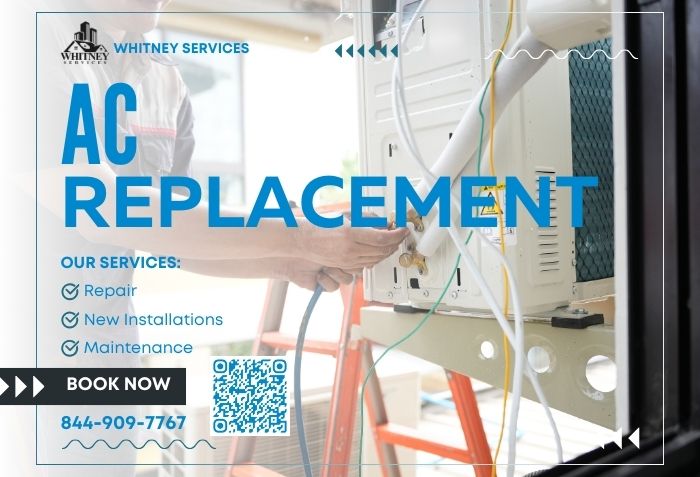
Air conditioners have finite lifespans, and knowing when to replace aging equipment rather than continuing to invest in repairs is one of the most important HVAC decisions homeowners face. Several clear indicators including age, repair frequency, rising energy costs, and efficiency decline help determine whether your cooling system should be replaced now or has reliable years remaining. Understanding these factors helps homeowners make informed decisions that protect comfort while maximizing value. At Whitney Services, we provide AC replacement in Brady Township, MI and help homeowners evaluate options honestly.
Understanding Air Conditioner Lifespan
Air conditioners in Michigan typically last 12 to 15 years with proper maintenance. Units approaching or exceeding this age range are entering the period when major component failures become increasingly likely and efficiency has declined from original specifications.
Age and expected lifespan are primary factors in replacement decisions. AC units manufactured before 2010 are 12 or more years old and approaching end of life. Units from the early 2000s are well past normal lifespan and operating on borrowed time.
Maintenance history dramatically affects lifespan. Air conditioners receiving annual professional maintenance regularly reach 15 years. Neglected units often fail at 10 to 12 years as dirty coils, low refrigerant, and worn components accelerate deterioration.
Michigan’s climate affects lifespan through extended cooling seasons compared to northern regions and thermal stress from hot humid summers. Units in Brady Township work hard during summer months accumulating wear faster than equipment in milder climates.
Manufacturing quality matters significantly. Premium brands with quality components last longer than budget equipment using inferior materials. However, even premium equipment reaches end of life eventually.
The Repair vs Replacement Decision
Several factors help determine whether repairing an aging air conditioner makes financial sense or whether replacement is the better investment.
The 50 percent rule provides a practical framework. If repair costs exceed 50 percent of replacement cost and the AC is past the midpoint of expected lifespan, replacement is usually smarter. For example, a $1,500 repair on a 10-year-old AC when replacement costs $6,000 sits at 25 percent, suggesting repair makes sense. A $2,500 repair on a 13-year-old unit when replacement costs $5,500 exceeds 45 percent and approaches the threshold where replacement should be seriously considered.
Repair frequency matters as much as individual repair costs. An AC requiring multiple repairs in recent years demonstrates unreliability that will continue and likely worsen. Cumulative repair costs over two to three years should be compared to replacement costs.
Age of equipment is critical. AC units under 7 years old with repairable problems should generally be repaired. Units 12 years or older with significant problems should be replaced. Units between 7 and 12 years require case-by-case evaluation.
Type of failure matters. Compressor replacement costs $1,500 to $3,000 and on a 12-year-old unit makes little sense when the rest of the system is also aging. Simple repairs like capacitors, contactors, or thermostats costing under $400 make sense even on older units.
High Energy Bills Indicating Efficiency Decline
Rising cooling costs provide early warning that air conditioners are losing efficiency and approaching the point where replacement saves more money than continued operation.
Compare current summer utility bills to the same months in previous years accounting for rate increases and weather differences. Cooling costs increasing 20 to 30 percent or more without corresponding usage changes indicate significant efficiency loss.
Air conditioners lose efficiency gradually as components wear, refrigerant leaks develop slowly, coils accumulate dirt despite cleaning, and systems drift out of optimal specifications. A 15-year-old AC may consume 30 to 40 percent more electricity than when new.
Efficiency decline compounds over cooling seasons. An AC consuming $800 in electricity annually when new may cost $1,200 annually at 15 years old. This $400 annual waste continues until replacement.
Modern efficiency standards mean new ACs are dramatically more efficient than units 12 to 15 years old. Replacement often pays for itself through energy savings within 7 to 12 years while providing improved comfort and reliability.
Understanding SEER2 Rating Requirements
New efficiency standards and rating systems affect air conditioner replacement decisions and help homeowners understand long-term operating costs.
SEER2 rating requirements became effective in 2023, replacing the previous SEER rating system with more realistic testing that better represents actual operating conditions. SEER2 ratings are approximately 4 to 5 percent lower than equivalent SEER ratings, so a 14 SEER unit under old standards equals approximately 13.4 SEER2 under new standards.
Minimum efficiency standards require 13.4 SEER2 for new installations in northern states including Michigan. This replaces the previous 13 SEER minimum. Units manufactured before 2023 using older SEER ratings are not affected by new standards.
Higher SEER2 ratings indicate better efficiency and lower operating costs. Mid-efficiency equipment achieves 15.2 to 17.2 SEER2. High-efficiency systems reach 19 to 21 SEER2 or higher.
Operating cost differences between minimum 13.4 SEER2 and mid-efficiency 16 SEER2 typically amount to $125 to $250 annually for average homes. Over 12 to 15 years, this represents $1,500 to $3,750 in cumulative savings.
Air conditioners manufactured 15 years ago typically operated at 10 to 12 SEER equivalent to 9.5 to 11.5 SEER2 under new standards. Replacing these units with 16 SEER2 equipment reduces cooling costs by 30 to 40 percent.
New Air Conditioner Cost Michigan Homeowners Should Expect
Understanding replacement costs helps homeowners budget appropriately and evaluate whether replacement timing makes sense.
Equipment costs for complete air conditioning replacement range from $3,000 to $6,000 for minimum efficiency 13.4 SEER2 systems, $4,500 to $7,500 for mid-efficiency 15 to 17 SEER2 systems, and $6,000 to $10,000 for high-efficiency 19+ SEER2 systems.
Installation labor adds $2,000 to $4,000 for straightforward replacements using existing ductwork, refrigerant lines, and electrical connections. Complex replacements requiring infrastructure upgrades cost more.
Total installed costs for air conditioner replacement typically range from $5,500 to $10,000 for most residential projects. This investment provides 12 to 15 years of reliable cooling when properly maintained.
Financing options make replacement affordable through monthly payments rather than large upfront costs. Many HVAC contractors offer financing through lending partners with terms from 24 to 60 months.
Utility rebates for high-efficiency equipment reduce net costs by $200 to $500 in many Michigan utility service areas. These rebates specifically target SEER2 ratings above minimum efficiency.
Tax credits under the Inflation Reduction Act provide up to $600 for qualifying high-efficiency air conditioners meeting specific SEER2 thresholds. Combined with utility rebates, total incentives can reach $800 to $1,000.
Signs Indicating HVAC System Upgrade Is Necessary
Beyond age and repair costs, several symptoms indicate air conditioners need replacement rather than continued repairs.
Refrigerant type matters significantly. Air conditioners using R-22 refrigerant should be replaced rather than recharged when leaks develop. R-22 has been phased out and costs $100 to $150 per pound making recharge uneconomical. A system needing 6 to 8 pounds costs $600 to $1,200 just for refrigerant.
Inadequate cooling that has progressively worsened despite repairs suggests the system has lost capacity through wear and can no longer meet home cooling demands.
Constant repairs where the AC requires professional service multiple times per season indicates the system is deteriorating throughout and will continue failing.
Loud or unusual noises including grinding, squealing, or banging suggest mechanical problems that will require expensive repairs or indicate imminent compressor failure.
Humidity problems where the AC runs but indoor humidity remains high indicate the system is not removing moisture effectively, often from refrigerant problems or worn components.
Safety concerns including electrical problems, refrigerant leaks, or components that overheat require immediate attention and often indicate the unit should be replaced.
Benefits of Modern Air Conditioner Technology
Replacing aging air conditioners provides benefits beyond simple cooling that older equipment cannot match.
Improved efficiency through modern compressor technology, better refrigerants, improved coil design, and advanced controls reduces operating costs by 30 to 40 percent compared to 15-year-old equipment.
Better humidity control from two-stage and variable-speed systems that run longer at lower capacity provides superior dehumidification compared to single-stage units that cycle on and off rapidly.
Quieter operation from improved compressor isolation, better fan blade design, and sound-dampening materials makes modern ACs significantly quieter than older units.
Smart thermostat compatibility allows remote control, scheduling, energy monitoring, and integration with home automation systems impossible with older equipment.
Improved reliability from better components, advanced diagnostics, and modern manufacturing quality means fewer breakdowns and longer service intervals.
Better warranty coverage on new equipment typically includes 5 to 10 year parts warranties and optional extended labor coverage providing protection older equipment lacks.
Timing Air Conditioner Replacement
Strategic timing of replacement maximizes value and minimizes disruption.
Spring replacement before cooling season begins provides best contractor availability, regular pricing rather than peak season premiums, and ensures the system is ready before summer heat.
Fall replacement after cooling season offers good pricing and availability but risks discovering problems too late if early heat waves occur the following spring.
Emergency replacement during summer heatwaves is most expensive and stressful. Contractors are overwhelmed, emergency rates apply, and families suffer in heat while waiting for installation.
Proactive replacement of units 12 to 15 years old during spring prevents summer emergencies and allows time to research options, compare quotes, and make informed decisions.
Why Choose Whitney Services
Air conditioner replacement represents a significant investment affecting comfort and costs for 12 to 15 years. Whitney Services provides expert AC replacement in Brady Township MI with licensed HVAC contractors who understand Michigan cooling demands.
We provide honest assessments of whether repair or replacement makes sense, perform proper load calculations for correct sizing, recommend appropriate efficiency levels based on your priorities, install equipment to manufacturer specifications, and back our work with solid warranties.
If your air conditioner is showing age-related problems or has exceeded its expected lifespan, contact Whitney Services today for a professional evaluation and accurate replacement proposal.
Frequently Asked Questions
Q1: How do I know if my AC needs replacing?
Air conditioners 12 years or older with repair costs exceeding $1,000, units requiring frequent repairs, systems using R-22 refrigerant with leaks, and ACs that no longer cool adequately despite repairs should be replaced rather than repaired.
Q2: Should I replace my AC before it fails?
Proactive replacement prevents summer emergencies, provides better contractor availability and pricing, allows time for informed decisions, and ensures the new system is ready before you need it. Replacing 12 to 15 year old units during spring is recommended.
Q3: What efficiency level should I choose?
Mid-efficiency 15 to 17 SEER2 equipment provides the best value for most homeowners, costing $500 to $1,000 more than minimum efficiency but saving $125 to $250 annually on cooling costs. This pays for itself within 5 to 8 years.
Q4: How much does AC replacement cost?
Complete air conditioner replacement costs $5,500 to $10,000 installed for most residential projects. Costs vary based on equipment efficiency, system size, and installation complexity. Financing options make replacement affordable through monthly payments.
Q5: Can I replace just the outdoor unit?
Replacing only the outdoor unit is not recommended. Indoor and outdoor components are designed to work together. Mismatched systems reduce efficiency, void warranties, and may not work correctly. Complete system replacement is best practice.